Articles

KPK ETH Yield Term is live on Euler. The vault supplies WETH into KPK-curated term markets where the rate is set fresh at the start of each calendar month, anchored to a benchmark for ETH staking rates rather than utilisation. Depositors earn a smoother, benchmark-anchored ETH yield: for the current cycle (June 2026), around 2.15% APY at normal utilisation, with the borrow rate fixed for the cycle. Borrowers, in turn, lock in their borrowing cost a full month in advance.
This is KPK's first fixed-rate market referencing benchmark rates, and the first time the discipline behind its other vaults, a documented risk framework, explicit collateral tiering, and agent-powered monitoring, reaches ETH credit on Euler. Predictable pricing is what lets capital lend and borrow at scale, and variable-rate markets rarely deliver it. KPK built this market on Euler, anchored to Treehouse's Decentralised Offered Rates (DOR) benchmark, to close that gap.
Why a fixed rate
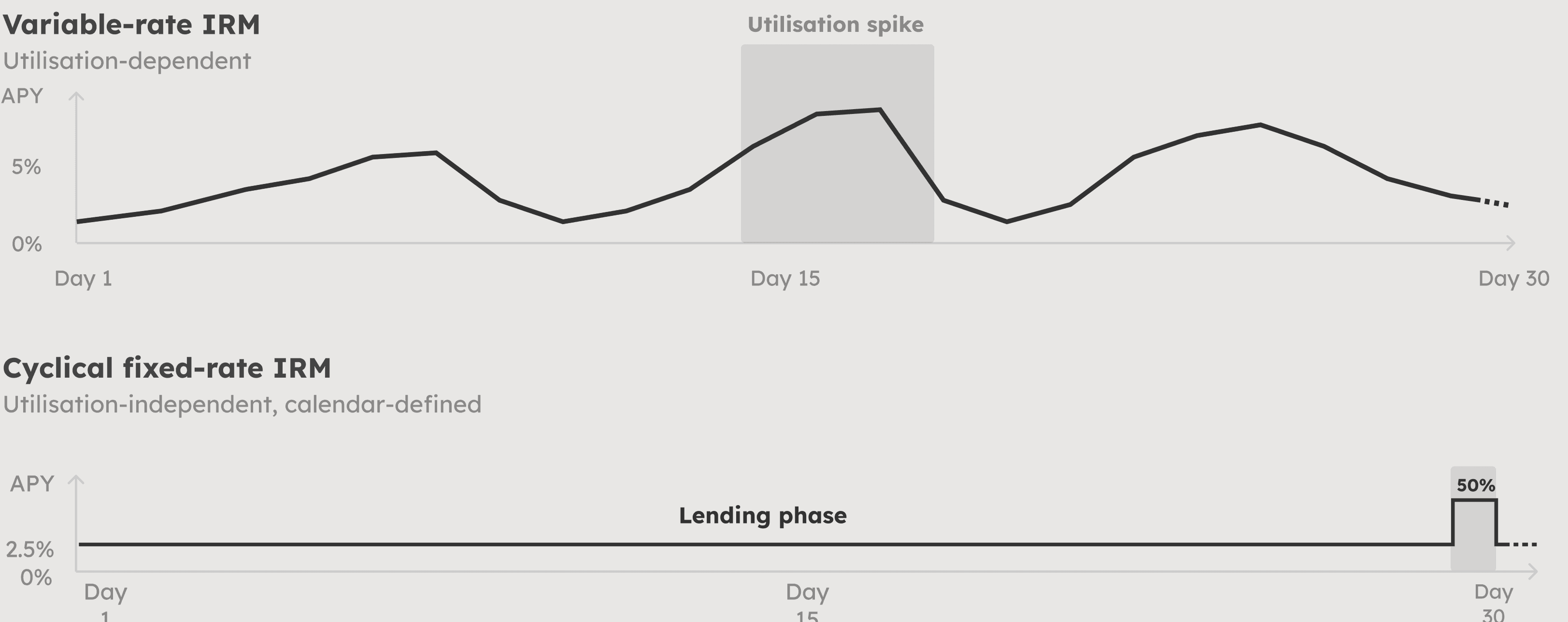
Variable-rate markets price ETH credit by utilisation. When a market fills up the borrow rate spikes, and when activity is quiet it sits below equilibrium. For anyone holding a position for weeks at a time, loopers especially, that makes the cost of capital hard to plan around, and the supply yield on the other side is just as noisy.
The spikes are not hypothetical. In May, a utilisation squeeze on a major variable-rate market pushed ETH borrow rates sharply higher, and the strategies and protocols borrowing there absorbed the cost with little warning. A rate that can triple overnight is difficult to build a position around. ETH Yield Term takes utilisation out of the equation. Within a cycle, the borrow rate is a single number, set once at the start of the month.
The monthly cycle
Each cycle runs the length of a calendar month, beginning at 00:00 UTC on the 1st.
For the first 29 or 30 days, the lending phase, borrowers pay a fixed WETH rate. The rate is not discretionary: it is derived each cycle from a documented formula tied to a benchmark for ETH staking rates. The interest-rate model has only two states, and it does not read utilisation, so there is no kink, no slope, and no jump rate. Mid-cycle, the rate stays constant regardless of new borrowers, deposits, or withdrawals.
The only scheduled change comes on the last day of the month, the repayment phase, when the rate steps up to 50% APY for up to 24 hours. The step-up encourages borrowers to repay or roll before the cycle resets. It does not force liquidations. A borrower who unwinds before the last day pays nothing extra, and carrying a position through the full repayment window adds roughly 0.111% to total borrow cost, about sixteen days of normal interest. A fresh cycle then begins at 00:00 UTC on the 1st at a new rate.

Setting the rate
The cyclical rate is set once at cycle start based on the Treehouse Ethereum Staking Rate (TESR), a panel-priced consensus benchmark for ETH staking yields. Under the current parameters, the formula keeps the borrow rate within a 2.05-2.50% APY band, in line with where the benchmark has historically printed, so the supply yield stays in a similarly stable range and does not drift mid-cycle. The input used for each cycle is recorded in the Euler change log; the next cycle's rate is set from the next TESR print, so the staking benchmark's path determines where the rate lands inside the band.
A depositor's realised supply rate over a full cycle approximates to:

The × 0.95 is the 5% KPK curator fee charged at the underlying markets; the (days − 1) / days factor reflects the brief repayment phase, which contributes negligibly to supplier yield. The Earn vault itself charges no performance or management fee.
For the current cycle, a TESR 30D print of 2.7920% gives a borrow rate of 2.3128% APY and a supply yield of around 2.15% APY once the markets reach normal utilisation. The supply yield is indicative, not fixed: while the borrow rate holds for the cycle, realised yield still varies with utilisation, the vault's allocation across markets, idle liquidity, and flows. That has typically sat above variable-rate ETH lending markets over recent months, as the comparison below shows.
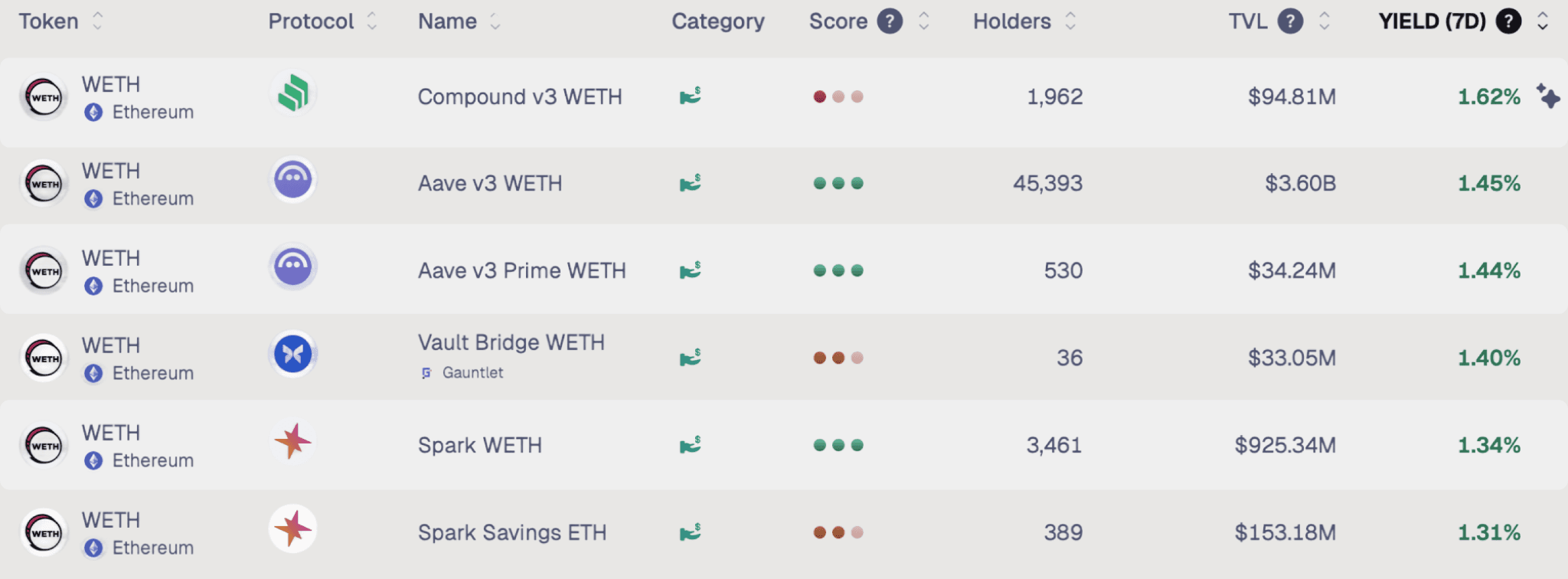
Example of current supply rates in major DeFi lending markets on Ethereum mainnet. Data from vaults.fyi (June 2nd 2026):
The markets and their tiers
KPK curates both the Earn vault and the underlying borrow markets. That means setting caps and LTV parameters, configuring oracle routing, installing the cyclical interest-rate model, and gating supply via an access-control hook, so only the Earn vault can lend into the cyclical markets and lender capital stays separate from outside supply. Each market is admitted under KPK's Risk Framework, assigned a risk tier and an allocation cap, with every parameter change logged in the public Euler change log.
Market | Collateral | Curator | Tier | Cap | LTV / LLTV |
wstETH Term | Lido wstETH | KPK | A | 90% | 94.5 / 96.5% |
tETH Term | Treehouse tETH | KPK | C | 75% | 89.5 / 91.5% |
Capital Prime Market | ETH, LST/LRT, BTC, stables | K3 Capital | B | 90% | per market |
wstETH is one of the deepest liquid staking tokens in DeFi; tETH exposure depends on the integrity of the Treehouse vault and its composition. Capital Prime is a complementary, variable-rate allocation that supplies baseline yield when the cyclical markets are under-utilised and provides withdrawal liquidity not tied to the monthly cycle. Because KPK does not curate it, its parameters and accepted collateral can change over time and are outside KPK's control.
Liquidations in the cyclical markets are driven by fundamental price only. KPK's oracles value wstETH and tETH at their underlying redemption ratio rather than spot, so a temporary market depeg does not trigger a liquidation. Only a real shortfall in the underlying assets, such as a major slashing event, can. Because the rate is fixed, it cannot accrue debt fast enough to push a position into liquidation mid-cycle.
Withdrawal liquidity
ETH Yield Term works like a monthly term deposit with conditional liquidity. The vault accepts deposits and redemptions continuously, but the underlying loans are committed across each cycle, so a depositor's ability to withdraw at any moment depends on how much of the cycle is still drawn by borrowers.
KPK targets a withdrawable buffer of about 10% through the lending phase, defended by the rebalancing agent and supported by the variable-rate Capital Prime Market allocation, which is not subject to the monthly cycle. For most depositors, that usually means a normal same-block withdrawal. During the end-of-month repayment phase, withdrawal capacity typically rises as borrowers unwind.
In exchange for a more predictable, benchmark-anchored yield, depositors give up some withdrawal flexibility within a fully drawn cycle. A large redemption during a fully utilised cycle may need to wait until borrowers repay at month-end. Live withdrawability, allocation, and realised yield will soon be tracked on the KPK Euler dashboard on Dune.
Monitoring and response
Every KPK vault on Euler is operated by its own dedicated agents, running the same monitoring stack and risk controls. The architecture is shared, but the execution is isolated.
KPK agents are deterministic programmes that execute a narrow set of whitelisted functions through KPK's Permissions Layer. They cannot withdraw funds to an external address or interact with markets that are not pre-approved. Within those bounds, the exit agent can pull exposure into idle WETH, and the rebalancing agent can refill the withdrawal buffer and steer allocations within their caps. The agents monitor borrow utilisation, rate shifts, oracle liveness, price divergence against reference venues, and available liquidity. Automated monitoring is fully in place today, and the rebalancing and exit agents are being rolled out in step with the vault's size, with full automation expected around mid-June 2026.
What ETH Yield Term is for
ETH Yield Term is for ETH holders who want a more predictable ETH yield and are comfortable positioning across a monthly cycle rather than expecting instant liquidity at every moment. The expectation is steady, predictable performance through the lending phase, with KPK's automation ready to act at the market level when conditions change.
It also signals a direction. KPK curates vaults across Morpho, Gearbox, and Euler, and this is the first where it sets the rate, not just the risk parameters. Bringing a benchmark-anchored fixed rate to ETH credit is part of building the market structure institutional capital needs to operate onchain.
KPK's curator role is bounded by design. Routine rebalancing between approved markets and within their caps executes through a scoped set of whitelisted functions. Anything that could expand the vault's risk, such as enabling a new market or raising caps, requires a 3-day timelock, with a Guardian able to intervene during the window. KPK does not use Euler's public Allocator role, reducing the attack surface. Every governance action is logged in the public Euler change log.
The vault is live now, and WETH deposits are open.
For borrowers
The same markets serve the other side of the trade. LST and LRT loopers can borrow WETH against wstETH or tETH at a rate fixed for the calendar month, with no exposure to utilisation spikes and no risk of a rate-driven liquidation. For a looped staking position held across weeks, that predictability is what makes the cost of the position knowable in advance.
The borrow rate sits below the staking benchmark by design: 90% of the benchmark, minus a further 20 bps, with the benchmark itself bounded between 2.5% and 3.0%.

A looped position earns the underlying staking yield on its collateral while paying this lower rate on the WETH it borrows; the gap is the carry. For the current cycle, a TESR 30D print of 2.7920% gives a borrow rate of 2.3128% APY, a carry spread of about 48 bps below the benchmark. The bounds keep the result inside the 2.05-2.50% APY band in every cycle, so the maximum borrow cost for the cycle, 2.50% APY at the top of the band, is known from the start.
The borrow guide sets out the full mechanics: market parameters, the repayment phase, and how to size a position against the monthly rate. Loopers who need more WETH than the market currently holds can reach KPK directly.
For asset issuers
These markets give borrowers a predictable way to loop yield-bearing ETH assets (LSTs, LRTs, or yield-bearing ETH-denominated vaults), scaling up the TVL of the underlying asset. The borrow rate is anchored to the Treehouse Ethereum Staking Rate (TESR), so the cost of looping moves with the staking market itself rather than with variable-rate utilisation. Loopers can size positions against a known monthly cost rather than guessing where a variable-rate model will go.
For shorter-term boosts, issuers can also run a temporary incentive programme on these markets. The calendar-aligned cycles make incentive flows easy to budget against, and short campaigns align cleanly with cycle boundaries.
KPK is open to coordinating co-incentive structures with issuers whose tokens are accepted as collateral. If you represent an LST or LRT issuer interested in these markets, contact [email protected] or use the contact form.
Links
Vault on Euler: KPK ETH Yield Term
Lender documentation: ETH Yield Term docs
Borrow guide: ETH Yield Term borrow guide
Risk framework: Risk framework
Change log: Euler change log
Benchmark: Treehouse TESR
Risk disclaimer
Vaults curated by KPK are non-custodial smart contracts and may carry significant risks, including possible loss of assets. KPK does not provide investment, legal, or financial advice. Past performance does not guarantee future results.
Share this article


