Articles

KPK USDC Prime RWA is live on Euler. The vault lets USDC lenders earn yield from tokenised US Treasuries and investment-grade credit, with collateral issued through Securitize and risk curated by KPK. Yuzu Money is the first borrower, using VBILL as collateral against USDC.
Income comes from real-world borrow rates, less correlated with broader crypto market conditions and incentive distribution.
The RWA collateral standard
For a tokenised RWA market to qualify as collateral in Prime RWA, three thresholds must be met.
Underlying fund quality. Established asset manager operating under regulated custody. VBILL is backed by VanEck's fund with State Street custody. STAC is a Securitize-launched fund of AAA CLOs, with BNY as service partner.
Compliance wrappers. Securitize governs both the DS Token (account-level freeze, seize, offboarding) and the Euler-side collateral vault.
Onchain pricing. Daily NAV is published through RedStone, with the Oracle Router governed by KPK's Curator Safe.
Every market that passes these thresholds receives a risk tier, a per-market allocation cap, and LTV and LLTV thresholds, all logged in the public change log before allocation begins.
Two RWA markets clear the bar today.
VBILL/USDC — the underlying VanEck fund holds cash, US Treasury bills, and repurchase agreements. The market is classified Tier A.
STAC/USDC — the underlying fund holds a diversified portfolio of US AAA Collateralised Loan Obligations. The market is classified Tier B.
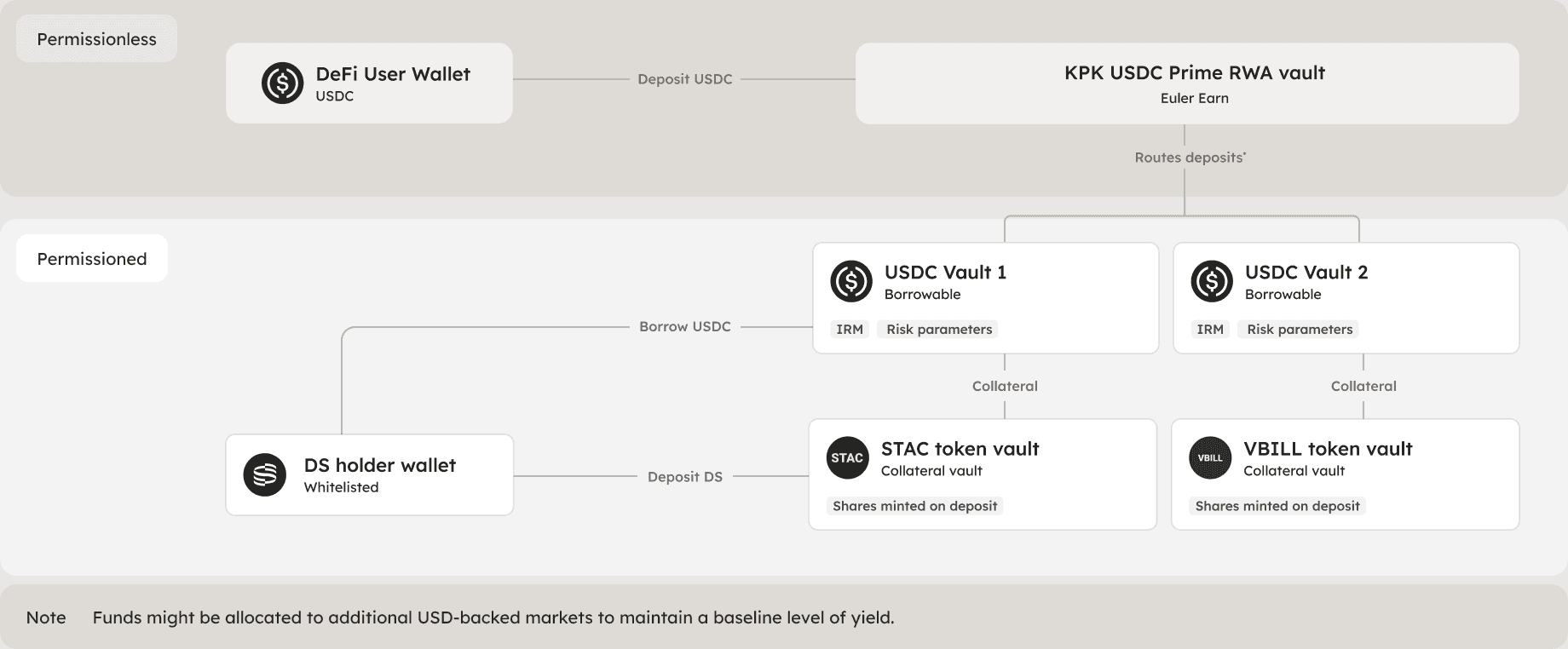
Alongside the core RWA markets, the vault holds a complementary allocation to the RLUSD/USDC market on Euler. RLUSD is Ripple's USD-backed stablecoin, with segregated reserves of cash and cash equivalents and regulatory oversight at issuance. The vault uses this market as a baseline yield source when utilisation in the Securitize-linked markets is low, keeping capital efficient without altering the vault's conservative posture.
Securitize handles issuance and compliance. Euler provides the modular lending architecture. RedStone delivers the pricing layer. KPK sets the parameters, governs the safes, and monitors the markets.
USDC lenders need no permission to supply the vault. Borrowers do, because the collateral itself is permissioned at the Securitize level.
What KPK monitors on Prime RWA
Every KPK vault on Euler is operated by its own dedicated agents, running the same monitoring stack and risk controls. The architecture is shared, but the execution is isolated.
KPK agents are deterministic programmes that execute a narrow set of whitelisted functions through KPK's Permissions Layer. They cannot withdraw funds to an external address or interact with markets that are not pre-approved. Within those bounds, the exit agent can pull exposure into idle USDC within seconds, and the rebalancing agent can refill the withdrawal buffer and optimise yield. Both act without waiting for human signatures.
Two layers operate in parallel. The exit agent responds automatically to exploit detection on Euler and Securitize contracts, issuer-side pause events on the collateral wrappers, and ownership-transfer events on the oracle feeds. KPK monitors the slower signals continuously, including oracle health, NAV drift, market utilisation, and fund-level announcements from the underlying issuers. Force-rebalances or market exits trigger when warranted.
Withdrawal liquidity
Prime RWA targets approximately a 15% instant-withdrawable buffer, defended by the rebalancing agent across deposits and withdrawals. Expected lender APY sits in a 2.5-5% range, varying with utilisation. Live withdrawability, allocation, and realised yield are tracked on the KPK Euler dashboard on Dune.
Yuzu Money as the first borrower
Yuzu Money is a premier "Yield-as-a-Service" platform, connecting curated on-chain yield strategies to the global neobank and fintech ecosystem. Yuzu Money's core products are vaults that provide plug-and-play structured products that enhance institutional-grade RWAs with DeFi mechanisms such as leverage and tranching.
Yuzu Money, with its Yuzu Prime product, is the first borrower on Prime RWA. Yuzu's position on Prime RWA uses VBILL as collateral to borrow USDC, which is then redeployed inside Yuzu's yield infrastructure. The mandate fit is direct: VBILL is the kind of treasury-grade tokenised collateral Yuzu's strategy is built around.
The initial size is modest by treasury standards, and is a working example of what the Prime RWA architecture enables: a regulated tokenised fund used productively as DeFi credit collateral, with the issuer's compliance controls intact and the lending venue fully onchain.
Borrowers looking to loop vetted RWA collateral can reach KPK directly. KPK supports onboarding through Securitize for borrowers who don't yet hold the underlying tokens, and scales vault liquidity to support positions larger than the market currently offers.
What Prime RWA is for
Prime RWA is for capital that wants yield from US Treasuries and investment-grade credit. Steady performance under normal conditions, with KPK's automation ready to act when conditions change.
KPK's curator role is bounded by design. Rebalancing within approved markets and caps is permitted; withdrawing funds or expanding the vault's permissions requires a protocol-enforced timelock. Every governance action is logged in the Euler change log.
USDC deposits are open to anyone, today.
Links
Vault on Euler: KPK USDC Prime RWA
Live metrics: KPK Euler dashboard on Dune
Product documentation: USDC Prime RWA
Governance and timelocks: Euler governance
Risk framework: Risk framework
Change log: Euler change log
Risk disclaimer
Vaults curated by KPK are non-custodial smart contracts and may carry significant risks, including possible loss of assets. KPK does not provide investment, legal, or financial advice. Past performance does not guarantee future results.
Share this article


